Episode Transcript
[00:00:00] Speaker A: How would you define your approach to marketing in one word and why?
[00:00:03] Speaker B: That's a really good question. It's hard to pick one word, but my favorite word is clarity. Most companies confuse activity with strategy and being busy is different than being productive. They're busy, but they might not be aligned. And I hear that a lot from business owners that they can't actually define their their very specific target audience. They get close, but there's always more work to do. And so when you don't know very specifically who you're going after, that lack of clarity creates a lot of spray and pray marketing and operational problems and accounting problems and HR tactics that really aren't hyper focused the way they should be. So I would pick clarity because I think it's the first step in a really clear, healthy, go to market revenue system.
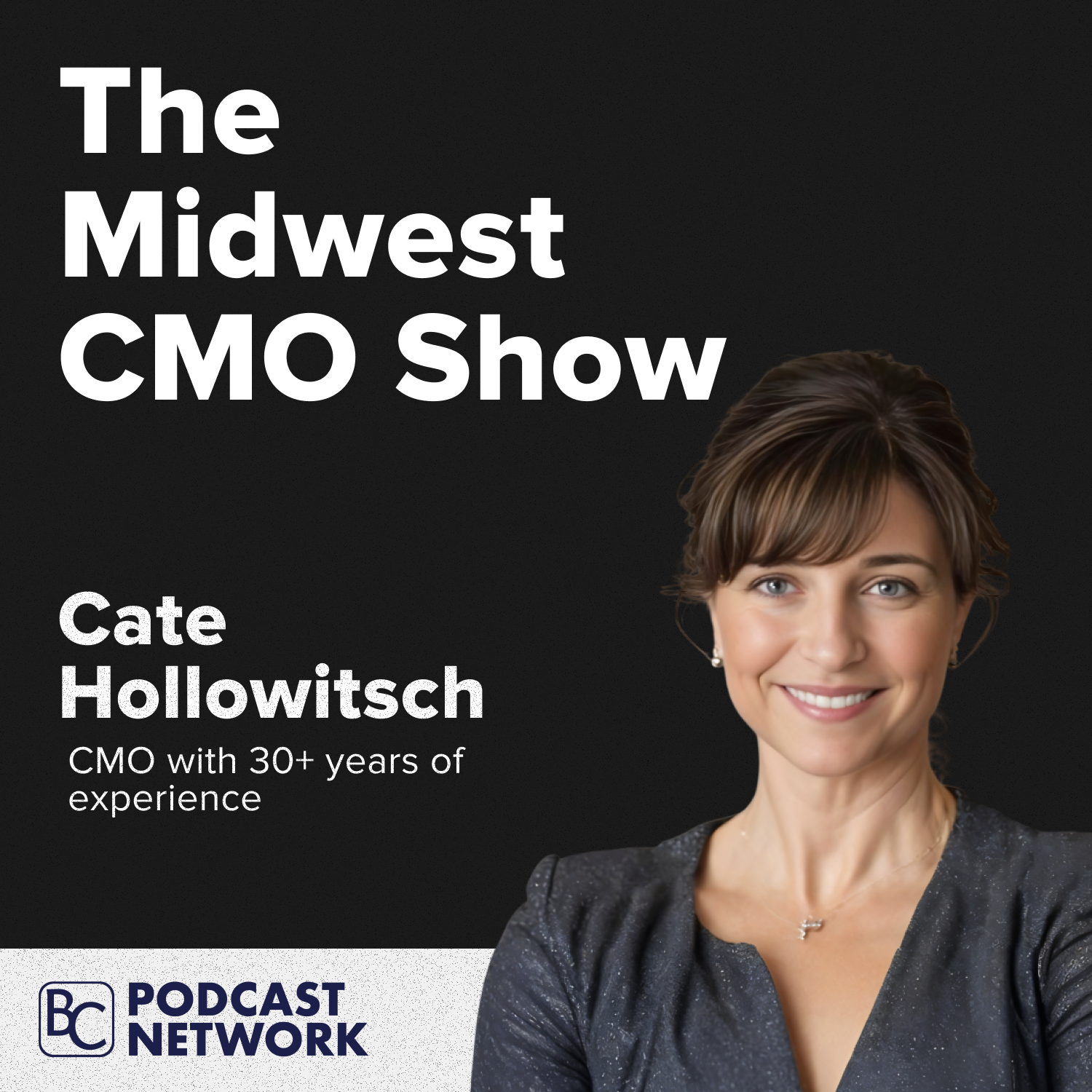
[00:00:58] Speaker A: That's Kate Hollowicz. She is an energetic, results driven CMO with over 30 years of experience. Her business success earned her a 2024 and 2025 spot as a Titan of Industry and she was selected as a 2024 female executive of the Year by the Stevie Awards. If you want to improve how you define and narrow your ideal customer, how you choose the right marketing levers based on customer fit, and how you drive sustainable growth through retention and expansion, then this episode is for you. Before we run the intro, our State of the Industry report from June breaks down where social media is now and where it's going. You can grab that via the link in the show notes. Let's run the intro. Welcome to the Midwest CMO Show, a podcast by Be Connected to help marketing leaders across the Midwest cut through the noise, make better decisions, and drive measurable growth through strategic conversations with your peers, the CMOs, VPs, and marketing directors who are helping grow successful businesses right here in our backyards. I'm Jordan and I lead growth here at Be Connected. Enjoy the conversation. Do you see clarity leading to focus? Or are those words synonymous? Potentially of like, clarity allows. Like is focus or does clarity.
[00:02:04] Speaker B: That's a really great way to say it. I think clarity leads to focus. So have you ever had one of those days when your list is just massive and you're. You're kind of like, do I do the little small easy things?
Do I do the big hard project? Do I do the head down thing? Do I just quickly respond to all these emails? Or you're in the middle of working on something and a big email comes in and you think it'll just take me 10 seconds to reply and then you have to reset to get back on track for whatever project you were doing.
Now imagine that at a business level you're experiencing that as you as the human on earth. But the same thing happens at a business level when you don't have that focus.
You're just looking at the whole list of things to be done and you can't figure out what to do first but that clarity around priorities. So then if somebody took that to do list of yours personally and you knew what your priorities were, whether that's moving revenue, needles or even if it's personal, you're getting ready for a party.
Your ultimate goal is to have a clean house for people to come over. So, so all the things on your list that have nothing to do with the clean house, there's your focus, right?
So same with the business level. The clarity on what you're trying to achieve and where you're going is what allows you to focus in on the actual work to be done and helps you laser in on the best uses of your time for that moment.
[00:03:29] Speaker A: That leads into my first question, Kate. Cause I think with marketing there's so many levers that one can pull to try to using like what a real lever is, getting water out from it. But certain levers take more work and only drip of water come and some you barely pull and just gushing water out. How do you think about for businesses specifically in the Midwest, what are some or the levers you think are really important to focus on first? That may lead to some of the clarity that you're speaking on.
[00:03:56] Speaker B: I love that question too. Because it doesn't matter what levers you pull if you don't have that customer level lever figured out. So if you do not have that customer lever nailed in and niched down as far as you possibly can go, the other levers don't matter. You can sit and pull them all the time and you're going to get lucky. You're going to have a spigot open and drinking from the fire hose with leads and sales and all the things.
But that's just luck really because it will eventually dry up. And then suddenly you're looking at this spigot that's dripping and thinking where'd they all go? And how many of those leads from those non clear focused segments resulted in the right revenue. All revenue is not created equal and the right product with the right customer is the sweet spot of where you want to be. And so you have to get that customer figured out correctly so that you can optimize the right product and the right margin for that specific customer. And then all the other levers just fall into place. It's almost like an instruction manual for Ikea furniture, right? When you know your customer and the product, you just go step by step. All the levers just line up and you know which ones to pull in what order. But without that you are just.
It's like a little kid's busy house with all the buttons and dials and knobs or whatever. You can do that all day long, but it doesn't mean anything's gonna open.
[00:05:21] Speaker A: I love that you talk about kind of doing that, pulling that lever first or trying to understand that because then that makes you have more leverage on all those other levers. Talk to me maybe, and every company is probably different with how they niche down or how they clarity on that. But just talk to me Maybe on some high level things that companies can do to just drill closer into who they actually are serving or their ideal audience.
[00:05:44] Speaker B: Nobody has to know everything about everything with their customer segment in order to do this. They can make some assumptions, they can make some swags, but all of those efforts are going to help them narrow it down. So let's use the example of an executive coach because this would be something we can all do easy math. I don't like doing math in public, so I have to do something that's easy math and I can make up numbers. So if you, Jordan, are an executive coach and I say, well, who's your audience?
And you say executives and I say bs, right? Because that's not true. So if you think about there's, I don't even know 2 million people in the United States that could be defined as an executive just based on their job title. So even if you just say C suite, job titles, CMO, CIO, CEO, folks with those kind of job titles, 2 million in the United States.
And you, Jordan, are only one guy. So how many of those 2 million are you actually going to executive coach in your lifetime?
Maybe a couple of thousand.
So you don't need all 2 million. So go ahead and niche down. So is it women executive? Let's say it's women executives. Let's just do easy math and say 50%. Right? 50% male, 50% female. So now we're down to a million women executives in the US that are your target audience. But even more than that, women executives at the high end of their career that are getting ready to leave and exit the workplace versus female executives that are entering their career. Very different needs, Very different needs. So let's assume Even that is just a 50, 50 split. Now you're down to 500,000 women. And let's say you're going to pick the high end women who are leaving their career soon, women that are leaving their career in the next six months, two years, five years.
Women that are in a male dominated industry.
Women of color. Like the further you niche down and define this audience that you're going to, the more specific your product is for them.
Because a woman who's leaving in six months and is not a female executive color and is not in a male dominated industry has very different needs from a coach than a female executive of color who is five years from retirement in a male dominated industry.
And so when you take all of those numbers down and you think about how many of that exact demographic is there in the world, plenty for you to have a sustainable career for the rest of your natural life. But it allows you to be very laser focused then on the product you're offering that person, the price you're going to charge, where you're going to find that person, what rooms you have to be in in order for those messages to be clear and the type of marketing activity you're going to do. It's going to drive what networks you need to join, what events you need to go to, what social media channels you need to be on. The color scheme of your email blast, right. Like it just, it makes all the decisions of everything beyond that much more clear. And so that niching down and even apply that to an aerospace engineer company, it's the same process, just at a different scale. So the characteristics are pulling all of those, those layers of the onion back even further.
Age, title, sometimes gender matters, location, geography. In some of the larger companies, maybe they don't export. So they're already geographically bound within the U.S. some of them might only be regional players.
And so you can automatically start thinking through all the parts of your customer profile that you can just keep boiling it down until it is almost scary.
Until it's almost scary tight. And that list of all of those possibilities of characteristics is going to depend on what market you're in.
[00:09:49] Speaker A: Yeah. I do appreciate you keeping the math simple for me. Do you have a approach on. Because a lot of the things you listed here were demographics. I know there's this other side of the coin psychographics. Do you have a place that you start with is the demographics a little bit more binary? Male, female, which even that can start to be not as binary. So like how do you know when to start with demographics? Psychographics or is it usually always a mix of both of like whittling down on both sides of it or only demographics do you focus on in the B2B space?
[00:10:22] Speaker B: I actually don't use demographics that much. So if you're a manufacturing company selling a widget to another company, it's an input into a bigger supply chain. It isn't. Or think of like you're a trucking company and you're selling transportation services to manufacturers.
That buyer Persona isn't necessarily gender related and to a certain degree that doesn't matter. That's more about is it an independent buyer or a buying committee?
So is it like a purchasing manager who makes these decisions or is it maybe an office administrator that takes it to a group of shareholders or a board or an executive team? Right. So you think through the buying process of your particular target audience.
Once you've determined maybe it's geographic based, maybe your widget is perishable and you don't ship it long distances.
And so now that's constraining you from a regional perspective. But the demographics of a B2B end up being things like employee size, revenue size, number of locations. So as you're thinking about your widget, that is an input, you're going to identify where you've had success.
Who have we sold to in the past that's been a brilliantly beautiful sale. They're happy, we're happy, it was easy, we hit all the marks, identify where you've done it before that worked pristinely and then you look at the places where it didn't work. Who's the kind of client we've had in the past that we want to fire.
And you look at the differences between the two and you're almost always going to find differences in size, differences in the leadership style, maybe family owned versus a publicly traded company, or that location issue. Maybe multi location places haven't been as great of a situation for your company as single locations have been. So the demographics in a B2B look different than in a B2C. And then once you pull those characteristics down, now you're looking at things like maybe their tech stack has something to do with it. So maybe you have found a weird connection between companies.
Customers that have a robust CRM work better for you than customers that are still doing things on paper.
As an example of a tech stack. Or maybe it's a marketing issue. If it's a company that has a full stack marketing team in it, maybe that doesn't work for a marketing agency. If you're a marketing agency and you're looking for potential customers. You look for companies that don't have full stack stack marketing because you're trying to fill a pain point. So now you're identifying more of those, I guess, psychographics of the inside of the company, how they make decisions, maybe their culture. Maybe you want to do investigations into brand values of particular clients because there could just be some that you're like, you know, we don't do business with that kind of company because they're just not our people. So now you can start looking at their brand and their background.
Maybe the type of product that they make is something you don't want to have anything to do with. And so you've eliminated those folks from your list as well. So you have to kind of think through B2B in just a slightly different way than demographics and psychographics. But in the B2C world it works the way you said.
[00:13:46] Speaker A: I love that. And I think it's easiest, at least for the tools I use. Usually the filters are demographic to start with. It's very hard to kind of find a psychographic filter just because it's so contextual. So I think I like your way of using the demographics to keep getting a shorter list and then from that shorter list you're able to maybe see if they align with your mission or some of those things that are less tangible. I find this super exciting, but I can imagine some people are like, oh, this like understanding how people buy. There's never like a pure answer. And I love that at the treasure hunt. And I think curiosity comes to my mind of like the thing that fuels it. Talk to me on how you view that more as an opportunity or excitement than like, oh, we have to like, you know, spend the time and never have an answer but keep kind of guessing and making assumpt. How do you find that, like to be fun or enjoyable?
[00:14:32] Speaker B: Yeah, I do love trying to peel back that how people think and how they buy because. And again, it doesn't have to be perfect. I don't have to hit the nail on the head about the customer. I just have to identify the types of behaviors and the way they purchase. Generally speaking, because each one of us are different. And the generalization is what's going to put two potential buyers that are relatively similar in the same bucket versus if you hit it precisely on the head, you're probably thinking of one specific buyer in the world and then what? And you need more than one. So generalizing it a little bit is going to make your pool of potential buyers a little bit broader. But you're also looking for generalities. So in terms of like a mom and you want to promote cheese to the mom, what are things that moms do? Are they involved in churches? Do they do yoga?
Do they go to a certain coffee shop? Are they a Dunkin Donuts or a Starbucks person? So you're making generalities about the type of behavior and the type of personality that that person has based on other things they interact with.
Because a Target mom and a Walmart mom or like a Kohl's mom or a JCPenney's mom could all be just slightly different. They have similarities, but they're all just slightly different. Maybe one is more price sensitive than the other, but that price sensitivity, if you're a premium product, might matter.
And so you might want to go with a Nordstrom mom versus a JCPenney mom or something to that effect. So when you're starting to kind of niche it down into those audiences, you do have to start making, you have to start eliminating.
And so it's, it's generalized. Not every target mom is exactly the same as the other target moment. But generally speaking, you can find some commonalities among them that help you think through the type of words you're going to use in your messaging or where you're going to boost your ad to. What other groups that they are potentially involved in are you going to boost the ad to so that it gets seen?
And that's kind of the trick. And Even in the B2B world, it's the same thing you're thinking through, okay, it's a manufacturer of this widget. Is there a widget association?
Would the people that I'm trying to target be members of that particular association? Would they be members at a state level or a national level?
What rooms are they hanging out in? What conferences do they go to? What newsletters do they read? So you're trying to pin all of that down so that you can focus in and get a lot of really good clarity on where to spend your marketing dollars.
[00:17:14] Speaker A: I love that so much. And maybe one final piece on this conversation topic you kind of hinted at, maybe I call them Sigma. But there are things that illuminate that for us. For example, be connected. We're selling to senior level marketers. There's a signal of someone who's new in a marketing role that kind of opens up many different options. And someone who has been in the same role for six, seven years, they have a maybe entrenched vendor that they're using an agency. So that was really curious for me of like, oh, it's even outside the demographics. There's these signals because there's a data that like 8, 4 out of 5 buyers aren't ready to buy at the moment. So you want to be on their short list. But if you are able to understand when that changes, when that signal of like they're ready to buy, talk to me about how you use that maybe in identifying the audience. Or is that maybe a more specific play to certain businesses where it makes sense of the sales?
[00:18:02] Speaker B: No, that is actually the actual question that I ask people is what triggers them to buy. So in some examples, it's a leadership change. If there's a big leadership change, that means new processes, new opinions, new favorite pet projects are coming into play and that stuff's gonna roll downhill.
So it could be leadership change, it could be a key role departs on the team. So yes, be connected may be looking for senior marketers, but you know as well as I do the senior marketer isn't actually sitting and pushing the buttons. But what's going to trigger the senior marketer to purchase is a departure on their team because now there's work to be done and nobody to do it. And we all know the hiring process is not two weeks.
So their two week notice is not going to hold you over until your role is hired. Right. So it could be a key vacancy on their team. It could be other maybe they just won a big grant or acquired a new business.
So depending on how specific you're getting with your audience, work you're thinking through, like in my case, we're in private equity, we buy other businesses.
So if you're watching press releases and you're like, hey, those folks at Nesnaventures just purchased another business and look at the size of that dog, they might need more help. Like there's triggers. And so it's actually asking yourself and your teams, what are the triggers that would make this person need our product?
And they are very specific moments in time. But those are important because that's how you identify where and how to watch for those signals. And there's signals. Could be. There could be two or three signals that signal the same pain point that would make a person need to have a maternity leave. Right. A lot of people are posting on LinkedIn, oh, so and so's out with the baby or on Facebook, like, none of this is secret anymore. Where when I was your age, this stuff was harder to find. Those signals were harder to find. But now it's very easy to set up Google alerts and other news type of scraping, web scraping systems to be able to look for the signals that if you're maybe you're a fractional person, you're looking for folks that are announcing maternity leave so that you could jump in and say, hey, I can cover your maternity leave.
[00:20:27] Speaker A: I love that. Kate, I think we're ready now to kind of jump into. If you had to write the playbook for Midwest marketers, for businesses to succeed in the Midwest, what are your three chapters or your three laws that they need to follow or adhere to?
[00:20:41] Speaker B: Well, my first one is the audience niching niche down until it hurts, until you are scared. You need to make yourself scared that what have I just done? If you are not feeling that way, you haven't niched down far enough. So that's the first step.
And then your second step is to think through the products that you sell to that niche and then think about the profit margin.
So this is what I meant by all revenues not created equal. If I'm selling shoes to people like you, Jordan, I may have three shoes that are appropriate to you.
Good, better, best.
And as the human on earth, you want best for the price of good.
[00:21:22] Speaker A: Correct.
[00:21:24] Speaker B: So you're naturally drawn to good because the pricing is appealing to you, but you want the qualities of best.
My profit margin may be optimized for my business at better.
See what I mean? So understanding that target demographic and then the various options of your product line for them and then thinking through your margins. But which of those products do I make the most money on?
Which means nothing if I'm not meeting the customer need.
So again, you want best for the price of good, which happens to be the better product in the middle. And that also happens to be where I make the most margin.
Win. Win.
So I may use the qualities of best in the marketing to pull you in and then you're loving the price issue at good.
And then the conversation happens in the middle and that's part of that customer journey is once you're into the system, you start balancing out between compromise. Which of the best qualities can I let go of to maintain a reasonable price? And you start thinking through what are nice to haves and what are need to haves in the solutions that you're trying to solve for yourself. So once you have that target market identified, then think through your product for that specific target and optimize the profit. And then your third step is define all the tactics that you need to do to Go find that person with that product in mind and marry the two up and just do that all day long and just repeat, rinse and repeat, rinse and repeat and don't go chasing squirrels like don't go getting off that playbook.
[00:23:10] Speaker A: Stay focused.
[00:23:10] Speaker B: Stay focused.
[00:23:11] Speaker A: I love your number two because I think and maybe you took this to just be Midwest businesses, but I think sometimes marketers, even though it's like the P is the 4P's product, it's maybe not an area that marketers instantly think of or maybe it is, but I love that because I think it is to drive drive more impact. Sometimes that senior market has to not go upchain but touch some of the things at which like if we're selling and the margin. I love that. How did you get to that realization? Was it just in the private equity? Seen so many businesses because I don't know if all marketers are whatever you'd call that business savvy or financial savvy that they want to and care about that, but I do think it's very important. So how did you realize that?
Was it just over time that it became clear of like oh, I need to care about the margins.
[00:23:59] Speaker B: It was over time. I don't think there was just this one like head slapping moment of other than we've all in our career had those moments where you're in a meeting of some sort and the CFO makes some comment about budgets or margins or profit and you're realizing I have no idea what she's talking about.
But younger in our careers I hope. But certainly as I have gone through executive coaching and leadership development, all of the things it did become rapidly clear to me that and it's not just a marketing problem hr it everybody needs to understand the financial levers of the business. You need to understand why people look at ebitda, why they look at net income, why they care about cash flow and how margin and all of these products contribute to that. You have to know what percent of your margin is driven by the different customer segments and then by the cross population of the product that goes with it. Customer Jordan if you're my profile, when you purchase product A, that combination contributes to margin differently than when you purchase product B, good or bad. But then customer profile Kate with those same two products also contribute differently for all the different reasons. Shipping, color, whatever your variations are on your particular product line. So understanding which customer profile combined with which product choice contribute the most to margin is what gives you those narrow focuses of where you need to spend Your time. It doesn't mean that you're not still selling other combinations out in the world. But when you're looking at, let's say, the Jordan and product, a combo contribute to 50% to the margin, then 50% of your effort.
Not necessarily time, like specific time, but effort, marketing, activities, messaging, work, the choices you're making.
50% of your time should be devoted to that customer who's contributing. Like, it's easy math. You should not be spending 50% of your time focused on a customer profile and product combination that drives 2% of your business. Like it doesn't. It's not sustainable. So everybody in every department needs to understand those levers and understand how each of those pieces contribute to revenue and why it matters. Because that's your CEOs challenge. That's your boss's boss's challenge. And knowing what they care about and what they're concerned about and speaking that language is really beneficial for your career.
[00:26:39] Speaker A: Yeah. I heard it once said the best marketers think like CEOs, and I think that that literally is what you just said, that they see either the big picture or they the financials, just because it gives you more information that can lead to clarity, which then can lead to focus. So I really like that. And it kind of connects that idea to your points. I really love that. All right, Kate, are you ready to jump into the fast five. Five quick questions, five quick answers. Yes.
[00:27:03] Speaker B: Okay.
[00:27:04] Speaker A: What is one of the biggest marketing mistakes you see Wisconsin businesses making? And you may have already touched on it.
[00:27:09] Speaker B: Today, it's chasing more leads. So to solve growth. So when. When you're. When revenue's off. Right. It's, oh, my gosh, give me more leads. And that's not necessarily the solution that you need. So again, it's that alignment and clarity on who you're selling to, because you probably already have the leads. You just need to go call Bob again and remind him that he needs to buy something. So chasing more leads in pursuit of growth is a huge problem.
[00:27:36] Speaker A: I have not yet mentioned, but you are a teacher of marketing at a college. But can you maybe talk about how you've seen many college graduates and you've even talked about hiring them? What's one quality you look for in them that maybe other senior marketing leaders or businesses just miss or don't value enough curiosity.
[00:27:54] Speaker B: That might be an obvious answer, but I can train anybody to do marketing, but I can't train them to be curious, to ask a better question to do the next thing.
But I think folks that go into marketing.
We're not necessarily numbers people. I made the joke about I don't do math in public. But you gotta do math in public if you wanna understand and net income and cash flow or you got to be besties at work with the cfo. You gotta, you have to figure it out. And in order to get your mind to a place where you can absorb hard things, you have to have curiosity and you just, you just have to want to know more and not be satisfied with whatever information was put in front of you. And ask one more question.
[00:28:40] Speaker A: You had a TEDx talk about letting go.
Not at all about marketing, but I'd love to hear how that can be applied to marketing decisions.
[00:28:50] Speaker B: Strategy is about saying no. So the whole idea of this focus and niching down on that customer segment is then who am I going to say no to?
And often the challenge is scarcity mindset. So when you niche down like that, people start thinking, okay, that's only 300,000.
In my executive coaching example, that's only 300,000 people.
But at a certain age, you know, if I was an executive coach, I'm in my 50s, I can't serve 300,000 people before I retire. So it is still plenty of a customer base. And that scarcity mindset sets in and folks want to then just say yes to any revenue opportunity that comes at them. So the bills are coming due, it's the end of the month. And I'm supposed to be lasered in on this target segment and this work to be done, but I'm not seeing revenue coming. And I know it's a bad deal if I go make this deal, but I'm gonna do it cause I need the revenue.
And that to me is that letting go. You have to let go of chasing something like that because it will put work on your plate that shouldn't be on your plate. And you're gonna pay for it eventually. Because now the work you're doing to implement that bad deal you made is preventing you from doing better work towards better revenue. And it's hard. It's really hard.
[00:30:09] Speaker A: What is one book or resource you find yourself recommending to marketers frequently?
[00:30:14] Speaker B: I love Never lose a customer again.
That's a really good book.
It's sort of what we were talking about of you can actually sustain your business and grow it over time without adding new customers if you just don't lose the ones you already have and then have them spend more. So that's a really good book for that angle. But also I love impact players. It's that concept of how do you, at any level of the organization, become an impactful player for the organization you're at. It's making yourself irreplaceable in a way. And it's just got a lot of little nuggets of this concept of not hiring people to do the functional ability, but you're hiring them for the traits you can't train, looking for the skill sets that will allow you to let them flourish in just about any opportunity. And it's just such a good book about how to show up and be accountable and do all the things and more that the organization is expecting you to do. So I recommend that book a lot.
[00:31:18] Speaker A: As an avid book reader, I'm always excited when I hear a book I've yet to consume, so I'm excited to buy both of those.
[00:31:23] Speaker B: Excellent.
[00:31:23] Speaker A: What is what is it? Finally, final question. What is one bold prediction for marketing's future? Mainly in the Midwest, but you can obviously take that to globally as well. But what is your bold prediction for the future of marketing?
[00:31:38] Speaker B: I hate to make it operational sounding because operational excellence is not a strategy, but efficiency is going to beat volume.
It isn't about having the most of a market share or increasing the number of customers.
It's increasing your revenue at a faster churn rate, doing it more efficiently because you've built really great relationships with customers and they're buying more, they're buying more often, they're bringing people in and you're replicating a repeatable playbook with that Persona over time versus so just you've heard the adage of how much money it takes to attract a new customer versus just keeping an existing one. But in an efficiency model or an effort model, it's the same story.
That famous example is money based, but if you think of it from efficiency and effectiveness and resources, it's the same. It takes time and sweat equity and energy from your team to go after new customers versus keeping the ones you already have and then adding to them, giving them more opportunity to buy.
[00:32:50] Speaker A: I love that, mainly because you didn't use AI in your answer. I feel it's very hard not to have AI slip into our future, but I do. I think it could have some impact on some efficiency or some of those things.
[00:33:02] Speaker B: At least from my earlier and you're right, it does. And that's what I use it for. My prediction of AI is that marketers who think marketers who know how to do the work of it are going to survive this AI generation because we are using AI to be more efficient. We're not using it to replace anybody. But there's a human discernment in our work that AI cannot provide.
Folks that are going to say, I'm not replacing that job because I'm going to let AI do it, you are going to pay that piper eventually.
But marketers that know how to think and because they're curious, they figured out how to use AI to improve work they're doing, not replace work. And then they add the human discernment onto it. And that ability to discern is part of that impact player mentality of Kate can't be replaced because nobody thinks like she does.
It isn't the actual day to day work I'm doing, it's the thinking that I'm doing that can't be replaced.
[00:34:01] Speaker A: I love that answer. That's something actually, I think, no pun intended quite a bit is how to improve how I think rather than. And even with people that I'm either mentoring, it's never to tell them what to think, but improving how they think about marketing. Because then AI can just help you be quicker or poke holes in things. But you have to ask that right question or you have to prompt it in a way.
[00:34:20] Speaker B: Which reminds me of another book recommendation, Thinking Fast and Slow. Have you read that one?
[00:34:25] Speaker A: Yes. Daniel Kahneman? Yes. That's a great book.
[00:34:27] Speaker B: Okay, then you've read that one. Yes. Classic.
[00:34:31] Speaker A: I can't be 0 for 3. I gotta be at least 1 for 3 on the books. All right, final question. Kaden, this is gonna be likely a summarization of a lot that you've said today, but what's the one thing that marketers listening to this should stop doing and start doing differently tomorrow?
[00:34:46] Speaker B: I am like a broken record, aren't I? Stop chasing everyone.
You cannot be everything to everybody, so stop it.
You're stepping over dollars to pick up a penny. You have to start defining that total relevant market, the total space of the type of customer that you're going after and stick in it. Perfect your marketing to that particular Persona combined with those product offerings and the growth will come. But you have to resist that urge to spray and pray and just go out there and do everything that's not going to get you your in.
[00:35:24] Speaker A: Stop chasing everybody and start niching down. I love it, Kate, and it literally kind of is a meta point that you have clarity on your advice and your wisdom, which I love. So thank you so much, Kate, for coming on the show and sharing all your wisdom. I know I gained so much from this conversation. Thank you.
[00:35:40] Speaker B: Well, wonderful. Thanks for having me, Jordan. This was a lot of fun.
[00:35:42] Speaker A: And this is the end of the podcast. That's a wrap on another episode of the Midwest CMO Show. If this episode helped you think differently about your marketing strategy, make sure to subscribe and leave us a rating. It helps other Midwest marketing leaders like you find these conversations and finally keep building and growing right here in the Midwest. We'll see you next time on the Midwest CMO Show.